
TCS-10 vs. Competing Models: Which Is Right for You?
 MARIN
MARINWhen selecting a CAN switch bridge for your industrial network, comparing the TCS-10 against competing models is essential for making an informed decision. The right choice depends on your specific application requirements, network complexity, and performance needs. The TCS-10 offers robust connectivity options, reliable signal integrity, and advanced filtering capabilities that set it apart in many industrial contexts. This guide examines how the TCS-10 compares to alternatives across key performance metrics, helping you determine which CAN switch bridge solution best aligns with your technical specifications and operational demands.
Understanding CAN-bus technology and its importance in modern industrial networks
CAN-bus technology serves as the backbone of communication in countless industrial systems, enabling reliable data exchange between multiple electronic control units (ECUs) within a network. Originally developed for automotive applications, this fieldbus solution has become indispensable across manufacturing, automation, transportation, and numerous other sectors.
At its core, CAN (Controller Area Network) provides a robust method for devices to communicate without a host computer, using a multi-master protocol that allows any node to transmit messages when the bus is free. This distributed approach eliminates single points of failure and creates highly resilient networks capable of operating in electromagnetically noisy environments.
The significance of selecting the appropriate CAN switch bridge cannot be overstated. These devices serve as critical infrastructure components that determine network performance, reliability, and scalability. A high-quality CAN switch bridge enables:
- Segmentation of network traffic to prevent congestion
- Isolation of network sections for troubleshooting and maintenance
- Expansion of existing networks without comprehensive redesign
- Filtering of messages to ensure priority data reaches its destination
As industrial systems grow increasingly complex and interconnected, the demands placed on CAN-bus networks continue to intensify. This makes the selection of components like the TCS-10 a decision with far-reaching implications for system performance, maintenance requirements, and long-term operational costs.
What is the TCS-10 CAN switch bridge and how does it work?
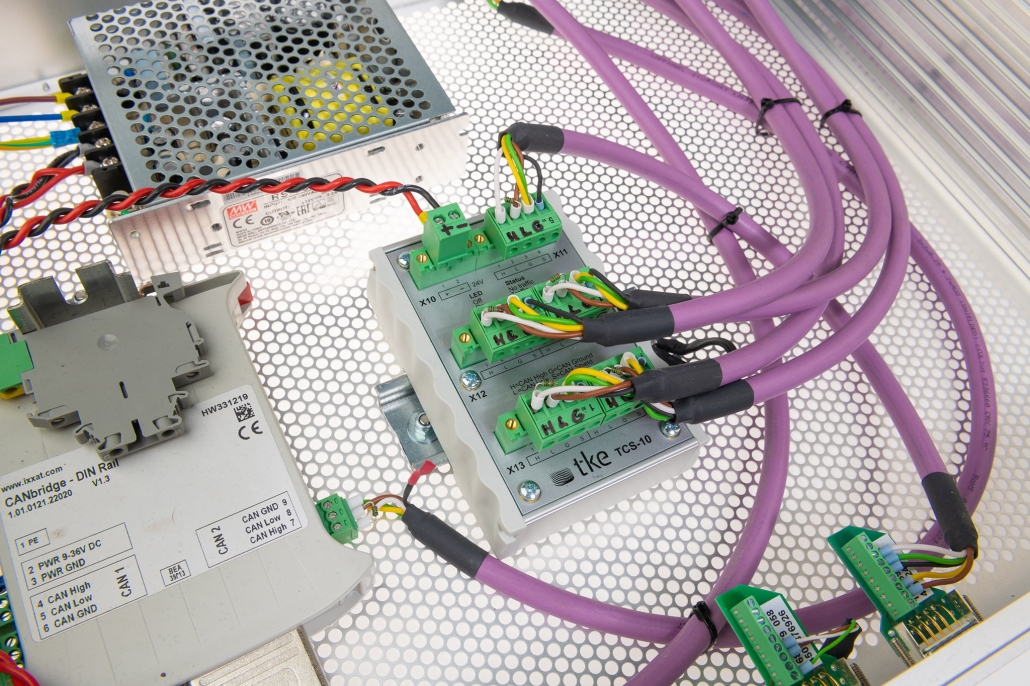
The TCS-10 is an advanced CAN switch bridge designed to connect and manage traffic between multiple CAN-bus segments within industrial networks. This intelligent device functions by receiving CAN messages from one bus segment, processing them according to configurable rules, and then selectively forwarding them to other connected segments.
At its hardware level, the TCS-10 features multiple CAN ports that support both standard CAN and CAN FD protocols, allowing for versatile implementation across various system architectures. The device operates by maintaining separate buffers for each connected bus segment, intelligently managing message priorities and traffic flow to prevent data collisions and optimize network performance.
Key technical specifications of the TCS-10 include:
- Support for both 11-bit and 29-bit CAN identifiers
- Configurable message filtering based on ID ranges
- Hardware-based message routing for minimal latency
- Galvanic isolation between CAN segments for enhanced reliability
- Industrial temperature range operation
- Status LEDs for visual diagnostic feedback
The core functionality of the TCS-10 extends beyond simple message forwarding. Its sophisticated filtering capabilities allow system designers to precisely control which messages traverse between network segments, creating logical separations that enhance both security and performance. This enables the implementation of hierarchical network architectures where critical control traffic remains isolated from diagnostic or monitoring communications.
How does the TCS-10 compare to other CAN switch bridges on the market?
When evaluating the TCS-10 against competing CAN switch bridges, several distinctive performance characteristics emerge. The TCS-10 delivers exceptional signal integrity across all connected networks, maintaining reliable communication even in environments with significant electromagnetic interference—a common challenge in industrial settings where many alternatives struggle.
In terms of connectivity options, the TCS-10 offers greater flexibility than many competitors. While basic CAN bridges typically connect just two network segments, the TCS-10’s multi-port design accommodates more complex network topologies without requiring additional hardware. This reduces potential points of failure and simplifies network architecture.
Message filtering capabilities represent another area where significant differences exist between available models:
- Basic bridges often provide simple pass/block filtering based on single IDs
- Mid-range alternatives may offer ID range filtering but with limited configuration options
- The TCS-10 implements sophisticated filtering with support for multiple ID ranges, priorities, and conditional routing
Performance under varying load conditions also differentiates the TCS-10 from alternatives. Many competing bridges experience degraded performance or message drops when network traffic approaches capacity. The TCS-10’s hardware-accelerated architecture maintains consistent throughput and deterministic behavior even under peak load conditions.
While the TCS-10 may represent a higher initial investment than some basic alternatives, its superior performance characteristics often result in lower total ownership costs when considering system reliability, maintenance requirements, and future expansion capabilities.
What are the unique advantages of choosing the TCS-10 for your CAN-bus network?
The TCS-10 offers several distinctive benefits that make it an advantageous choice for modern industrial networking applications. Perhaps most significantly, its exceptionally robust design ensures remarkable uptime performance, with mean time between failures (MTBF) metrics that exceed industry standards—critical for applications where network downtime translates directly to operational losses.
Implementation simplicity represents another key advantage. Unlike competitors that require extensive configuration via proprietary software tools, the TCS-10 offers straightforward setup options that reduce commissioning time and complexity. This user-friendly approach extends to ongoing maintenance, with clear diagnostic indicators and intuitive troubleshooting processes.
The TCS-10’s forward-compatibility with evolving CAN standards provides valuable future-proofing for network investments. While many competing devices support only legacy CAN protocols, the TCS-10’s architecture accommodates both current and emerging standards, protecting against premature obsolescence as network requirements evolve.
Technical support accessibility creates another significant differentiation point. The TCS-10 is backed by responsive, expert assistance from specialists with deep understanding of industrial CAN applications—contrast this with the generic support often available for mass-market alternatives.
Finally, the TCS-10’s reliability under extreme environmental conditions exceeds many competing models, with verified performance across extended temperature ranges, vibration exposure, and power supply fluctuations commonly encountered in demanding industrial settings.
Which industries and applications benefit most from the TCS-10 solution?
The TCS-10 delivers exceptional value in manufacturing environments where network bridge solutions must maintain reliable communication between production equipment, control systems, and enterprise networks. Its robust filtering capabilities prove particularly valuable in preventing non-essential traffic from interfering with time-critical control functions.
Transportation systems represent another sector where the TCS-10 excels. In railway applications, the device’s ability to create logical separations between safety-critical and non-critical systems satisfies stringent regulatory requirements while maintaining operational efficiency. Similarly, in maritime installations, its resilience to environmental challenges makes it ideal for shipboard control networks.
Mobile equipment manufacturers benefit significantly from the TCS-10’s capabilities. Construction, agriculture, and mining machinery often incorporate multiple CAN networks with different priorities and timing requirements. The TCS-10 enables these networks to interconnect while maintaining appropriate isolation between systems like engine management, hydraulic controls, and operator interfaces.
Process industries with distributed control systems find the TCS-10 particularly valuable for creating manageable network segments that simplify troubleshooting and maintenance. When implemented strategically, these segmented architectures improve overall system reliability while reducing diagnostic complexity.
Energy management systems, from power generation to distribution monitoring, leverage the TCS-10’s reliability in harsh environments and its capability to prioritize critical alarm and control messages over routine monitoring traffic.
Key considerations when selecting the right CAN switch bridge for your specific needs
When evaluating whether the TCS-10 or an alternative CAN switch bridge best suits your requirements, begin with a thorough assessment of your current and anticipated network complexity. Simple point-to-point connections may be adequately served by basic bridges, while networks with multiple segments, varying priorities, or mixed protocol requirements typically benefit from the TCS-10’s advanced capabilities.
Carefully analyze your environmental operating conditions. Projects involving exposure to extreme temperatures, vibration, or electromagnetic interference demand robust solutions like the TCS-10, while controlled environments might accommodate less ruggedized alternatives.
Consider your technical support resources and capabilities. Organizations with limited in-house expertise in industrial networking generally achieve better outcomes with solutions like the TCS-10 that offer comprehensive support, whereas teams with specialized CAN expertise may successfully implement a wider range of options.
Future expansion plans should significantly influence your decision. If you anticipate network growth or protocol evolution, the TCS-10’s scalable architecture provides valuable flexibility compared to more limited alternatives.
Finally, conduct a thorough cost-benefit analysis that considers not just initial acquisition costs, but ongoing operational impacts:
- Potential downtime costs from component failures
- Engineering time required for configuration and maintenance
- Lifespan expectations under your specific operating conditions
- Future-proofing value against evolving network requirements
By systematically evaluating these factors against your specific application requirements, you can determine whether the TCS-10’s advanced capabilities justify its investment for your particular industrial networking scenario.
Interested in real-world automation solutions?
Browse our case studies to discover how we support safe and efficient operations through smart control and networking systems