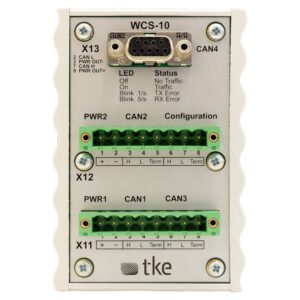
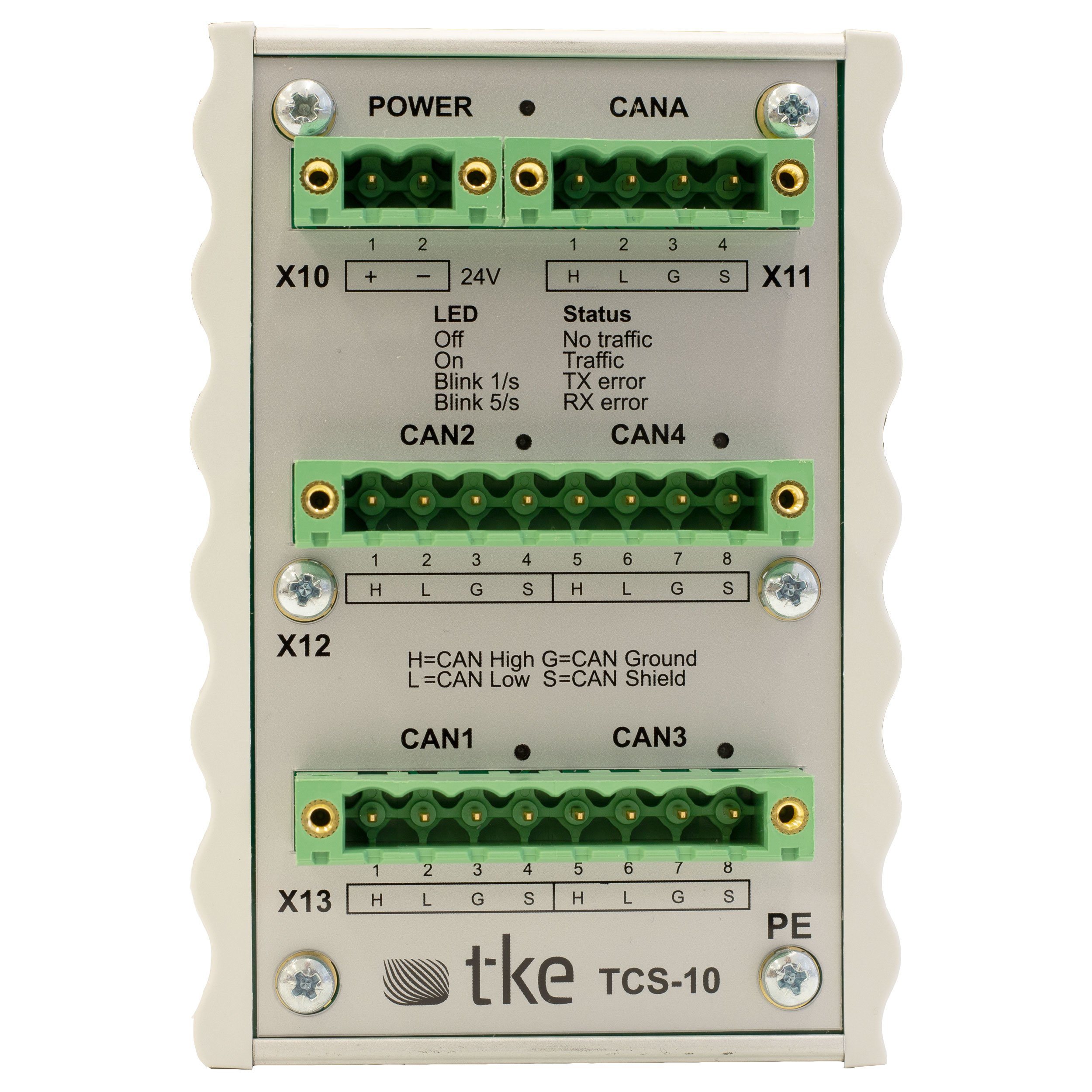



TCS-10 intelligent CAN switch & bridge for segmented CAN networks
TCS-10 CAN Switch is a versatile CAN switch designed for a wide range of industrial applications. Its compact housing with DIN-rail mounting ensures easy integration into most installations. With the TCS-10, you can efficiently build star- or tree-topology CAN networks.
TKE TCS-10 is an intelligent CAN switch and bridge designed for segmented CAN network architectures in industrial, automotive, energy storage, and off-highway applications. It enables reliable communication between multiple CAN bus segments while improving network stability, reducing bus load, and isolating electrical disturbances.
With four switched CAN ports and a dedicated CANopen configuration port, the TCS-10 allows flexible star and tree topology CAN networks with configurable message routing and support for different CAN bitrates on each segment.
Key features
- 4 × Switched CAN Ports
Supports segmented CAN networks with independent routing and configurable communication paths. - Dedicated CANopen Configuration Port
Separate CAN interface for diagnostics, monitoring, and remote configuration. - Flexible Network Topologies
Supports star and tree-shaped CAN architectures with optimized bandwidth and segment lengths. - Independent CAN Bitrates
Each CAN segment can operate at different bitrates (125, 250, 500, 800, 1000 kbps). - Configurable Message Filtering
Messages can be selectively routed between network segments to reduce unnecessary traffic and improve performance. - Galvanic Isolation
Electrical isolation between CAN segments prevents disturbances from propagating across the network. - DIN-Rail Mountable Housing
Compact industrial enclosure designed for control cabinets and industrial installations. - CANopen Configuration & Diagnostics
Dedicated fifth CAN port for CANopen-based configuration, diagnostics, firmware updates, and active network monitoring without DIP switches or manual hardware setup.
Functionality
A CAN switch (or CAN bridge) is an intelligent device that connects multiple CAN networks, even if they operate at different bitrates. Although the buses are not electrically connected, messages can be read from one CAN bus and optionally filtered before being retransmitted on one or more other buses.
- Four independent CAN network segments
- Support for different bitrates per segment (125, 250, 500, and 1000 kbps)
- Configuration via CANopen using the CAN A port
TCS-10 operates as an intelligent CAN bridge that reads CAN messages from one network segment, optionally filters or modifies routing behavior, and retransmits messages to selected CAN segments. Unlike traditional repeaters, the TCS-10 selectively routes traffic only where needed, significantly reducing CAN bus load and improving network efficiency.
By electrically isolating CAN branches, the device prevents faults, short circuits, and electromagnetic disturbances from affecting the entire system. Each segment functions independently and can use different CAN bitrates optimized for network length or bandwidth requirements.
The dedicated CANopen configuration port allows active diagnostics, firmware updates, and monitoring without interrupting the switched network operation. Ideal for engineers and system integrators who need reliable segmented CAN networks with improved fault isolation, optimized bus load, and flexible CAN topology management in demanding industrial environments.
Benefits of TCS-10 CAN switch
Implementing the TCS-10 CAN switch in your CAN bus system provides significant technical advantages:
- Electrical isolation between CAN segments reduces risk of system-wide failures
- Fault containment: Short circuits and disturbances are limited to a single bus segment
- Optimized CAN bus load through selective message forwarding
- Extended network reach: Lower bitrate segments allow longer cable distances
- Flexible CAN topology design (star, tree, hybrid structures)
When bus segments are electrically separated, any short circuits or other electrical disturbances are isolated to the segment in which they occur. This allows the other branches of the network to continue operating normally. The bus load can be reduced if not all messages are retransmitted to each branch. One branch could use a lower bitrate, which would allow the bus length to be increased to a few remote nodes. The TKE CAN switch/bridge has four switched CAN ports and an additional CAN port for configuration.
Configuration over CAN
The TCS-10 CAN switch is fully configurable via CANopen, using a dedicated fifth CAN port for configuration and monitoring. This allows connection to a separate CAN network for diagnostics and monitoring.
Alternatively, the configuration port can be connected to the switched network, enabling access from an HMI or bus master node. This flexibility also makes it possible to place the configuration port in a more accessible or safer location, even if the switch itself is installed in a hard-to-reach or hazardous environment.
CAN bitrates and other settings can be configured via included software, or any standard CANopen configuration tool. The TKE CAN switch does not contain any DIP switches, eliminating mechanical wear and ensuring long-term reliability in industrial environments.