
Are Kvaser tools compatible with J1939 and ISO 11898?

Yes, Kvaser tools are fully compatible with both J1939 and ISO 11898 protocols. Kvaser hardware interfaces support the complete J1939 protocol stack while simultaneously conforming to the ISO 11898 physical layer specifications. This compatibility enables engineers and developers to use Kvaser tools for comprehensive CAN bus development across industrial, automotive, and heavy machinery applications. The interfaces allow for real-time monitoring, diagnostics, and development of systems using these widely adopted protocols without requiring additional specialized hardware.
Understanding Kvaser tools and CAN bus protocols
Kvaser tools are specialized hardware interfaces designed for Controller Area Network (CAN) communication systems. These interfaces serve as the critical bridge between computers and CAN networks, enabling developers to access, monitor, and interact with CAN bus systems across various applications.
At their core, Kvaser interfaces translate CAN messages from the physical bus into data formats that development software can interpret. This capability makes them essential tools for engineers working with embedded vehicle networks, industrial automation systems, and other CAN-enabled technologies.
Protocol compatibility represents a fundamental consideration when selecting CAN tools. Different industries have standardized on specific CAN protocols to meet their particular requirements. Automotive engineers need tools that understand high-speed CAN communications, while heavy-duty vehicle developers require J1939 protocol support. Kvaser’s approach to compatibility ensures their tools work across these diverse implementation scenarios.
What are J1939 and ISO 11898 protocols?
J1939 and ISO 11898 represent two critical but distinct elements of modern CAN bus communication systems. While often mentioned together, they address different layers of the communication stack.
J1939 is a higher-layer protocol developed specifically for heavy-duty vehicles and off-highway equipment. Standardized by the Society of Automotive Engineers (SAE), J1939 defines message formats, network management procedures, and diagnostic communication for applications like agricultural machinery, construction equipment, and commercial trucks. It specifies how data is organized, addressed, and transmitted across the network, creating a common language for diverse vehicle systems.
In contrast, ISO 11898 defines the physical and data link layers of CAN communication. This international standard specifies electrical characteristics, signaling methods, and bit timing for CAN networks. ISO 11898-1 covers the data link layer, while ISO 11898-2 defines high-speed CAN physical characteristics (up to 1 Mbit/s) and ISO 11898-3 covers fault-tolerant, low-speed CAN implementations.
These protocols complement each other in practical applications. J1939 typically runs on top of the physical layer defined by ISO 11898, creating a complete communication solution for complex vehicle systems.
Are Kvaser hardware interfaces compatible with J1939 protocol?
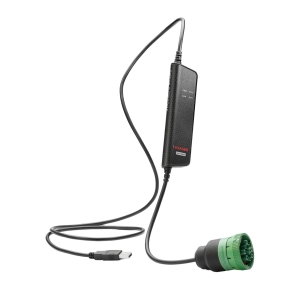
Yes, Kvaser hardware interfaces fully support J1939 protocol communication. These interfaces can capture, interpret, and transmit J1939 messages across CAN networks, making them ideal tools for heavy-duty vehicle development, diagnostics, and testing.
Kvaser’s compatibility with J1939 extends across their product range, from entry-level Leaf interfaces to advanced Memorator Pro devices. This support enables engineers to access the complete J1939 protocol stack, including its specific addressing schemes, multi-packet messages, and network management functions.
When working with J1939 applications, Kvaser hardware handles the crucial transport protocol elements that allow large data sets to be broken into multiple CAN frames and reassembled correctly. This capability is essential for diagnostic operations and parameter configuration in complex vehicle systems.
Configuration for J1939 communication typically requires selecting the appropriate bit rate (usually 250 kbit/s for standard J1939 applications) and specifying J1939 as the protocol type in the accompanying software. Many Kvaser interfaces support multiple channels, allowing simultaneous connection to different CAN networks running various protocols.
How do Kvaser tools support ISO 11898 implementations?
Kvaser tools provide comprehensive support for ISO 11898 implementations across all its variations. Their hardware interfaces are designed to comply fully with both the electrical and timing specifications defined in the ISO standard.
For high-speed CAN applications (ISO 11898-2), Kvaser interfaces support data rates up to 1 Mbit/s with precise timing and excellent signal integrity. This capability makes them suitable for demanding automotive applications where message timing is critical. Their hardware manages the differential signaling requirements specified in the standard, ensuring reliable communication even in electrically noisy environments.
Kvaser’s support extends to low-speed, fault-tolerant CAN implementations (ISO 11898-3) as well. Select interfaces can operate at the lower bit rates common in these applications while handling the different electrical characteristics of fault-tolerant CAN networks.
The physical connections on Kvaser interfaces typically feature standard 9-pin D-SUB connectors that follow industry conventions for CAN pinouts. This standardization ensures compatibility with existing CAN networks and simplifies integration into development environments.
We invite you to explore our case study section to see practical examples of how our customers have implemented Kvaser tools in various ISO 11898 applications.
Which programming languages can be used with Kvaser tools for J1939 development?
Kvaser tools support a wide range of programming languages for J1939 development, giving developers flexibility to work in their preferred environment. This multi-language support is delivered through Kvaser’s comprehensive API (Application Programming Interface).
Python developers can leverage the CANlib library for Kvaser interfaces, which provides a complete set of functions for sending and receiving J1939 messages. Python’s simplicity makes it excellent for rapid prototyping and testing of J1939 applications.
For performance-critical applications, C and C++ remain popular choices. Kvaser’s C API offers low-level access to hardware features while maintaining cross-platform compatibility. This approach is particularly valuable for embedded systems development where resource efficiency is paramount.
C# and .NET developers can use Kvaser’s managed libraries, which wrap the core functionality in classes that integrate seamlessly with modern Microsoft development environments. This option combines programming convenience with access to advanced J1939 features.
LabVIEW integration is available through dedicated drivers, allowing test engineers to incorporate J1939 communication into graphical test applications. This integration is particularly valuable in automated testing scenarios for heavy-duty vehicle components.
Additionally, many third-party J1939 protocol stacks and middleware solutions have been designed to work with Kvaser hardware, further expanding the available development options.
Key takeaways about Kvaser tools and protocol compatibility
Kvaser tools offer comprehensive compatibility with both J1939 and ISO 11898 protocols, making them versatile solutions for CAN bus development across multiple industries. This compatibility stems from their thoughtful hardware design and robust software support.
When implementing Kvaser hardware for protocol-specific applications, several best practices emerge. First, selecting the appropriate interface type is crucial – USB interfaces offer simplicity and portability, while Ethernet options provide superior performance for high-bandwidth applications. Second, proper termination of CAN networks remains essential for reliable communication regardless of the protocol in use.
For J1939-specific development, Kvaser’s Memorator Pro and Leaf Pro interfaces offer the ideal balance of features and performance. These devices provide hardware timestamp accuracy essential for analyzing timing-sensitive J1939 message sequences, along with the necessary bandwidth for handling the often message-heavy J1939 networks.
When working with varied ISO 11898 implementations, Kvaser’s multi-channel interfaces allow simultaneous connection to different CAN networks, simplifying development for complex systems that incorporate both high-speed and low-speed CAN buses.
The combination of hardware compatibility and extensive software support makes Kvaser tools a reliable choice for developers working with these industry-standard protocols, enabling efficient development workflows from initial prototyping through to production testing.